September 16, 2026 Engineered to Be Chosen, What Jordan Reveals About Where Global Capital Now Lands
Where a company puts its next operation is no longer mostly about cost. Firms now weigh how deep the talent runs, how stable the rules are, how connected the market is, and how well the wider environment is built to support them over the long term.
Jordan shows what that looks like in practice. Global technology and consulting firms that could set up almost anywhere already run real operations in Amman, supported by incentives, infrastructure and policies the country has built deliberately around the needs of international business.
The places that attract patient capital work just as hard to lower its risk as its cost. Jordan is taking that approach through its investment framework, its digital infrastructure and its focus on anticipating future technology shifts. Through the National Council for Future Technology, Jordan is building a mechanism to look ahead at technological change and ensure that its policies, regulations, talent and incentives can evolve with it.
When a company chooses where to put a regional operation, it is making a bet it expects to live with for years, not for one budget cycle. For a long time, that decision came down largely to wherever the work was cheapest. Now it comes down to something harder to replicate: a place where skilled people are actually available, where the rules are steady and improving, and where the system around a business is built to keep working as it grows.
That shift is quietly moving capital toward a smaller group of countries that have deliberately set out to be chosen.
The most telling sign of how a market is judged is where global capital actually goes.
By that measure, more firms are choosing Jordan.
Who is already in Jordan
The clearest evidence is simply who already works there. A look at the ecosystem tells the story: Amazon, Microsoft, Oracle, Cisco, Samsung, Deloitte, PwC, EY, KPMG, Concentrix and BIGO all run offices or delivery centres in Amman. These are companies that could go almost anywhere, and their continued presence reflects decisions made around talent, operating conditions, connectivity and long-term potential.
That is not a marketing endorsement. It is a decision made with real money, again and again.
The wider trend points the same way. Foreign direct investment into Jordan reached $2.0 billion in 2025, up 25% on the year and the highest level since 2017. When firms with the whole world to choose from keep arriving in one place, they are making a judgement that a spreadsheet can only partly capture: that what they build there will continue to be worth investing in years from now.
Built on purpose
None of that confidence is luck. Jordan has built its offer deliberately, rather than competing on price alone.
Income from exported services is tax-free, an exemption now written into law through 2033. There is no tax on profit distribution or capital gains, while domestic technology income is taxed at just 5%. IT firms also pay no sales tax and no customs duties on imports, reducing both the cost and friction of establishing and expanding an operation.
But incentives are only one part of the equation.
Technology parks such as King Hussein Business Park give companies an established place to land and connect with the wider ecosystem, while government programmes help support the cost of hiring and training new technical staff.
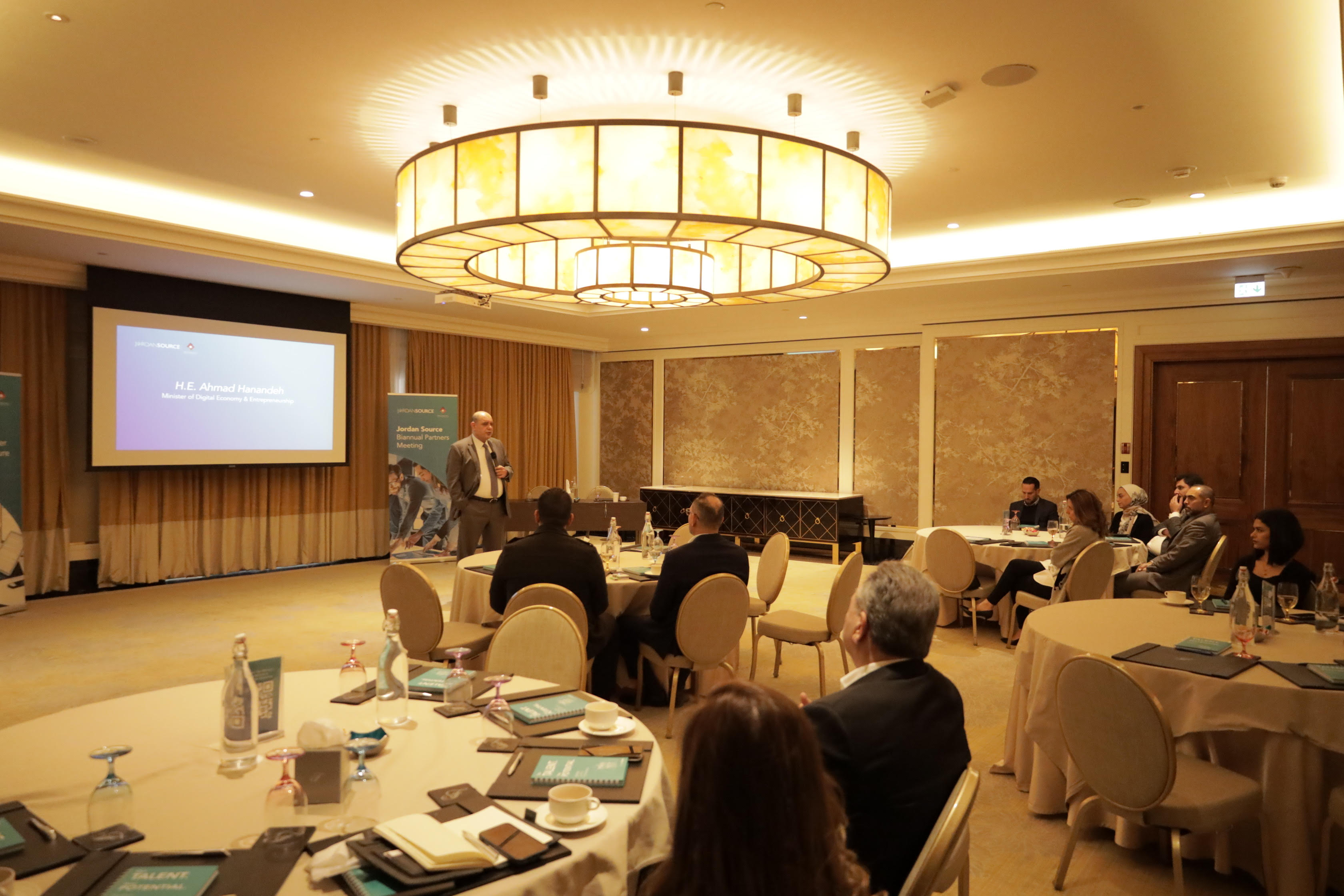
Tying that ecosystem together is Jordan Source, the national technology and creative-economy program delivered through the Ministry of Digital Economy and Entrepreneurship under the Youth, Technology and Jobs project. Jordan Source connects international businesses and investors with Jordan’s talent, technology ecosystem and opportunities, providing a government-backed front door into the market.
The message to an investor is straightforward: others have already tested Jordan’s efficiency, talent and operating environment, and companies considering the market can build on that foundation.
Why companies stay
Companies stay where the thing they need most is in steady supply. In Jordan, that thing is people.
About 63% of Jordan’s roughly 12 million citizens are under 30, and the country produces more than 50,000 university graduates, with about a fifth specialising in ICT. English is taught for 12 years of school, and Jordan ranks among the top five in MENA for English proficiency, while more than 30 universities operate in two languages.
Universities including Princess Sumaya University for Technology, the University of Jordan and Al-Ahliyya Amman University are part of a wider network of more than 30 institutions feeding the talent pipeline, supported by more than 100 technology programmes covering fields such as artificial intelligence and cybersecurity.
But Jordan does not simply rely on its young population. It actively grows the talent.
Through the Youth, Technology and Jobs programme, backed by the World Bank, and the DigiSkills association established under it, workers are retrained and certified for the skills employers actually need. That includes industry-specific training as well as areas such as low-code development and microelectronics.
That distinction matters. A large young population creates potential; a system that continually develops its skills turns that potential into a long-term business advantage.
For a company that depends on specialised engineers and digital talent, knowing that skilled people are available today — and that the pipeline is being continuously renewed for tomorrow — is what turns a place from somewhere you operate into somewhere you build.
Wired in, and within reach
A base is only as useful as what it can reach, and Jordan is built to reach a lot.
The Aqaba Digital Hub connects Europe, Asia and Africa through next-generation subsea cable infrastructure. Its facilities cover 18,000 square metres, with Tier III certification and 99.982% uptime. The Coral Bridge system provides 48 fibre pairs and more than 1 petabit of capacity between Jordan and Egypt, while connectivity to London can reach latency of around 70 milliseconds from Tier III-certified facilities.
At home, internet penetration tops 99%, while more than 45 direct air routes connect Amman to major business hubs.
From that base, a company can serve a regional market of more than 400 million people, and reach well beyond it. Jordan’s agreements provide access to 155 countries, underpinned by 8 free trade agreements, 39 double taxation agreements and 49 bilateral investment treaties.
Jordan was also the first Arab country to sign a free trade agreement with the United States, and trade between the two countries has grown by more than 800% since the agreement was signed.
The significance of this connectivity goes beyond geography. For modern businesses, access is not simply about how close a market is. It is about how efficiently people, data, services and capital can move across borders.
Lowering the risk, not just the cost
The places that attract patient capital work just as hard to lower its risk as its cost, and Jordan has built a number of mechanisms around that principle.
The Jordanian dinar has been pegged to the US dollar since 1995, while inflation has remained around 2%, giving investors a more predictable basis for planning costs and returns. Jordan continues to meet the targets of its IMF programme, reflecting a focus on maintaining macroeconomic stability.
Investors also have a legal right to repatriate their capital, profits and dividends in full through the regulated banking system. The country’s 49 bilateral investment treaties form another part of that framework, providing protections intended to give foreign investors greater certainty when committing capital.
The rules are improving too, not simply holding.
The 2022 Investment Environment Law put foreign and local investors on the same footing, opened more sectors to incentives and made it easier to bring specialised staff into the country. The framework has continued to evolve through subsequent regulatory changes aimed at simplifying procedures and reducing administrative barriers.
And through the National Council for Future Technology, established in 2025, Jordan is making a habit of looking ahead at technology shifts and considering how its rules, talent plans and incentives need to evolve before those shifts become business realities.
When a company is making a commitment for years rather than months, that kind of foresight becomes its own form of risk management.
Where this is heading
Jordan has set itself the goal of lifting foreign direct investment to 5% of GDP by 2035, as part of a wider ambition to establish the country as a global, top-tier technology hub.
The direction is clear, but the opportunity now is to build on the momentum already visible across investment, talent, infrastructure and market access.
The race for digital investment will only become more competitive. As AI and other technologies reshape where companies operate and how teams work, the choice of where to build will become increasingly important. Companies will continue to look for places that offer not just competitive costs, but the combination of skilled people, reliable infrastructure, predictable rules, access to markets and the ability to adapt as their needs change.
That is the combination Jordan is building.
The most revealing measure of an investment environment remains where companies actually put their people, operations and capital. Companies do not choose a country for one budget cycle. They choose it for what they believe they can build there over the next five, ten or twenty years.
That is what it means to be engineered to be chosen.
The next question is not whether Jordan can support your growth. It is what you could build here.
Explore Jordan’s technology ecosystem, meet the talent and discover what makes Jordan a growing destination for global business.
Discover Jordan. Discover what comes next.
More News